What is Structured Data?
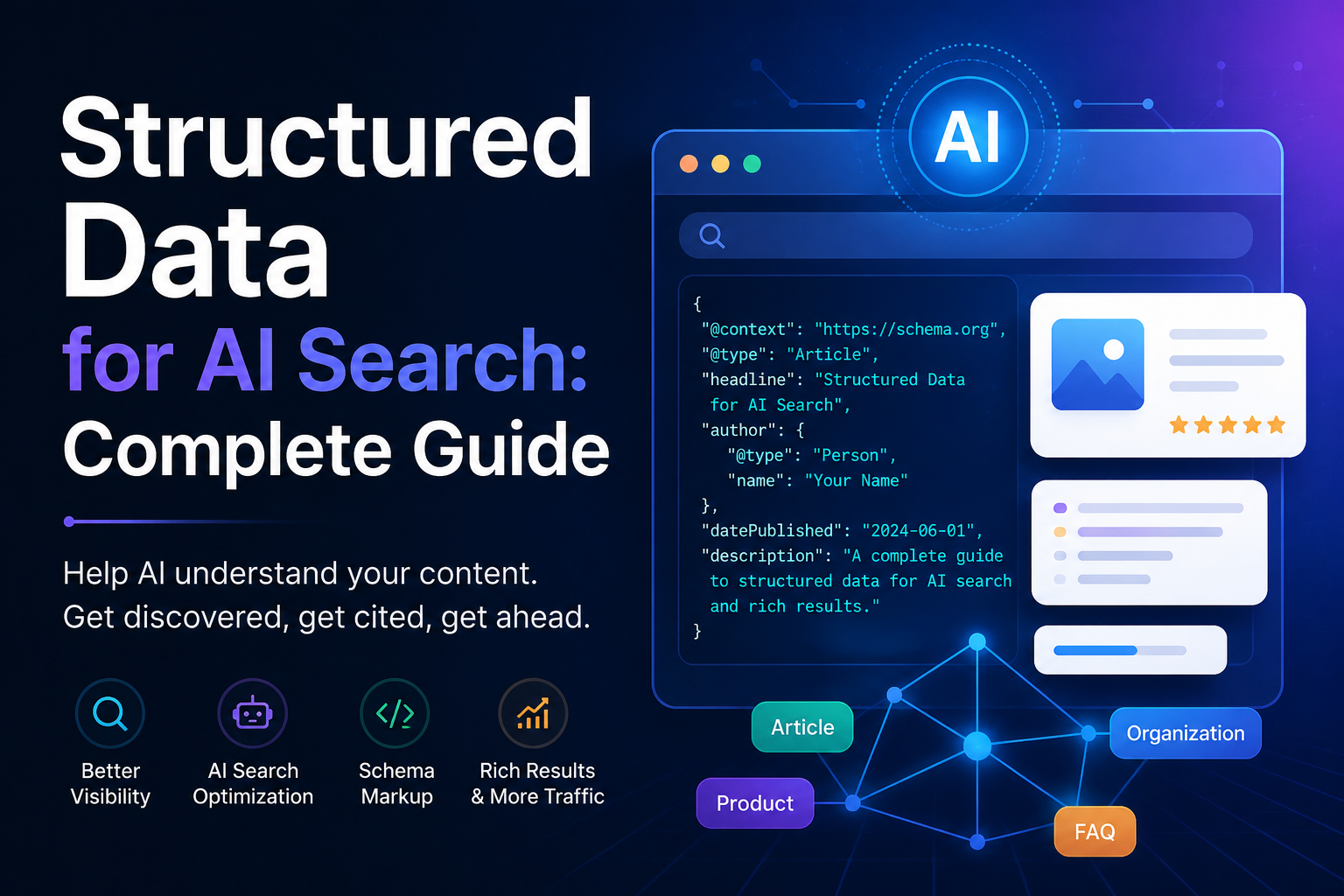
Structured data is code you add to your web pages to help search engines and AI systems understand your content. It provides context about what your content means, not just what it says.
When you add structured data to a page about a recipe, you tell search engines “this is a recipe, here are the ingredients, here is the cooking time, here is the rating.” Without structured data, search engines only see text.
I started using structured data on my own site in early 2025. Within three months, I noticed more consistent citations in ChatGPT and Perplexity responses. The difference was noticeable.
Structured data uses a standardized format called schema.org. This vocabulary was created by Google, Bing, Yahoo, and Yandex to provide a common language for describing web content.
Why Structured Data Matters for AI Search
AI search engines process information differently than traditional search engines. They need to understand context and meaning, not just keywords.
When ChatGPT or Perplexity crawls your site, structured data helps them:
- Understand what type of content you have
- Extract key information accurately
- Identify relationships between concepts
- Generate more accurate citations
Without structured data, AI systems have to guess what your content means. With it, they know exactly what they are looking at.
For more on optimizing for AI search, see our GEO SEO complete guide, ChatGPT SEO guide, and Perplexity SEO guide.
Types of Schema Markup
Article Schema
For blog posts, news articles, and editorial content.
{
  "@context": "https://schema.org",
  "@type": "Article",
  "headline": "How to Optimize for AI Search",
  "author": {
    "@type": "Person",
    "name": "BePhil"
  },
  "datePublished": "2026-06-12",
  "dateModified": "2026-06-12",
  "description": "A complete guide to GEO SEO optimization.",
  "image": "https://bephil.com/images/article-image.webp",
  "publisher": {
    "@type": "Organization",
    "name": "BePhil",
    "logo": {
      "@type": "ImageObject",
      "url": "https://bephil.com/logo.png"
    }
  }
}
FAQ Schema
For question-and-answer content. This can appear as rich results in search.
{
  "@context": "https://schema.org",
  "@type": "FAQPage",
  "mainEntity": [
    {
      "@type": "Question",
      "name": "What is GEO SEO?",
      "acceptedAnswer": {
        "@type": "Answer",
        "text": "GEO stands for Generative Engine Optimization. It means optimizing your website so AI-powered search engines can find, understand, and cite it in their answers."
      }
    },
    {
      "@type": "Question",
      "name": "How do I optimize for ChatGPT search?",
      "acceptedAnswer": {
        "@type": "Answer",
        "text": "Create clear, direct content that answers specific questions. Use structured data, build topical authority, and keep content fresh."
      }
    }
  ]
}
HowTo Schema
For step-by-step tutorials and guides.
{
  "@context": "https://schema.org",
  "@type": "HowTo",
  "name": "How to Add Schema Markup to Your Website",
  "description": "Step-by-step guide to implementing structured data.",
  "step": [
    {
      "@type": "HowToStep",
      "name": "Choose the schema type",
      "text": "Identify what type of content you are marking up and select the appropriate schema type from schema.org."
    },
    {
      "@type": "HowToStep",
      "name": "Generate the code",
      "text": "Use Google's Structured Data Markup Helper or a schema generator to create the JSON-LD code."
    },
    {
      "@type": "HowToStep",
      "name": "Add to your page",
      "text": "Insert the JSON-LD code in the head section of your HTML or use a tag manager."
    },
    {
      "@type": "HowToStep",
      "name": "Test the markup",
      "text": "Use Google's Rich Results Test to validate your structured data."
    }
  ]
}
Organization Schema
For company and business information.
{
  "@context": "https://schema.org",
  "@type": "Organization",
  "name": "BePhil",
  "url": "https://bephil.com",
  "logo": "https://bephil.com/logo.png",
  "description": "Thoughts on design, technology, and the craft of building digital experiences.",
  "sameAs": [
    "https://twitter.com/bephil",
    "https://github.com/bephil"
  ]
}
Breadcrumb Schema
For navigation breadcrumbs.
{
  "@context": "https://schema.org",
  "@type": "BreadcrumbList",
  "itemListElement": [
    {
      "@type": "ListItem",
      "position": 1,
      "name": "Home",
      "item": "https://bephil.com"
    },
    {
      "@type": "ListItem",
      "position": 2,
      "name": "Blog",
      "item": "https://bephil.com/blog"
    },
    {
      "@type": "ListItem",
      "position": 3,
      "name": "Article Title",
      "item": "https://bephil.com/blog/article-slug"
    }
  ]
}
How to Implement Structured Data
Method 1: JSON-LD (Recommended)
JSON-LD is the recommended format. Add it to the head section of your HTML:
<head>
  <script type="application/ld+json">
  {
    "@context": "https://schema.org",
    "@type": "Article",
    "headline": "Your Article Title",
    "author": {
      "@type": "Person",
      "name": "Author Name"
    }
  }
  </script>
</head>
Method 2: Microdata
Add attributes directly to your HTML elements:
<div itemscope itemtype="https://schema.org/Article">
  <h1 itemprop="headline">Your Article Title</h1>
  <span itemprop="author">Author Name</span>
  <time itemprop="datePublished" datetime="2026-06-12">June 12, 2026</time>
</div>
Method 3: Tag Managers
Use Google Tag Manager or similar tools to inject structured data without editing HTML directly.
Testing Your Structured Data
Google Rich Results Test
Visit https://search.google.com/test/rich-results to validate your markup. This tool shows:
- Whether your schema is valid
- What rich results you are eligible for
- Any errors or warnings
Schema Markup Validator
Visit https://validator.schema.org/ for detailed validation. This tool checks:
- Schema syntax
- Required properties
- Data types
- Relationships
Google Search Console
Monitor your structured data in Google Search Console:
- Go to Enhancements section
- Check for schema errors
- Monitor rich result performance
Best Practices for AI Search
1. Be Accurate
Only mark up content that actually exists on the page. Fake or misleading structured data can result in penalties.
2. Be Complete
Include all required properties for each schema type. Missing properties reduce the effectiveness of your markup.
3. Be Consistent
Keep structured data consistent with your visible content. If your schema says one thing but your page says another, search engines will distrust your markup.
4. Update Regularly
Keep your structured data current. Update dateModified when you update content. Add new schema types as your site grows.
5. Use JSON-LD
JSON-LD is easier to implement and maintain than microdata. It also separates structured data from your HTML, making updates simpler.
Common Mistakes
Mistake 1: Missing Required Properties
Each schema type has required properties. Missing them reduces effectiveness.
Mistake 2: Incorrect Data Types
Properties expect specific data types. A date property needs a date format, not a string.
Mistake 3: Fake Ratings
Do not add review schema to content that has no reviews. This violates Google guidelines.
Mistake 4: Hidden Content
Do not add structured data to content that is hidden from users. This is considered deceptive.
Mistake 5: Not Testing
Always test your structured data before publishing. Errors prevent rich results from appearing.
Structured Data for AI Citations
To optimize for AI citations specifically:
Include Author Information
AI systems value authoritative sources. Include author name, credentials, and links.
Add Publication Dates
Fresh content gets cited more often. Include accurate publication and modification dates.
Reference Sources
If your content cites other sources, include that in your structured data. This builds credibility.
Use Specific Types
Be as specific as possible with your schema types. “TechArticle” is better than “Article” for technical content.
Conclusion
Structured data helps both traditional and AI search engines understand your content. It provides context that plain HTML cannot convey.
Start with Article schema for your blog posts. Add FAQ schema for question-answer content. Test everything with Google’s Rich Results Test.
The effort you put into structured data today will pay off as AI search continues to grow. Sites with proper structured data will be cited more often and more accurately.
For more on AI search optimization, check our GEO SEO complete guide, ChatGPT SEO optimization guide, and technical SEO audit checklist. For crawlability details, read the website crawlability guide. For performance, see the Core Web Vitals guide. For the latest changes in AI search, see AI search trends for 2026.
Thanks for reading! If you’re feeling overwhelmed by all the technical details, take a deep breath. You don’t have to implement everything at once. Start with one schema type, master it, then move to the next. Progress, not perfection. Have a wonderful day, and keep building amazing things!