Since the rise of ChatGPT, Google AI Overviews, Claude, Perplexity, Gemini, and other AI-powered search systems, a new term has exploded across the digital marketing industry: Generative Engine Optimization (GEO).
Many marketers are treating GEO as if it has replaced traditional SEO.
That assumption is wrong.
The reality is much simpler:
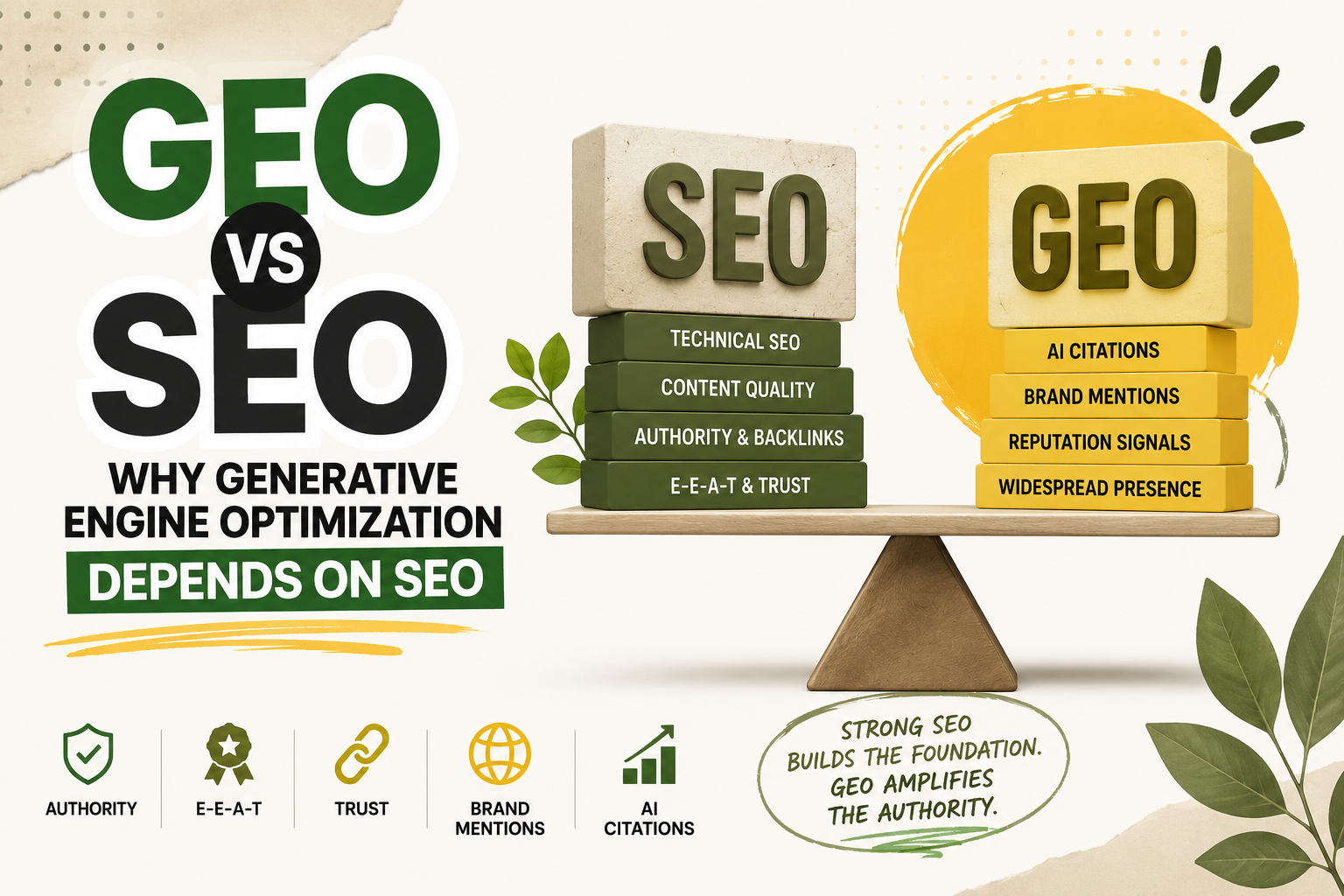
GEO is not a replacement for SEO. GEO is built on top of SEO.
Without strong SEO fundamentals, GEO becomes an empty strategy with no foundation. If search engines cannot discover, trust, index, and understand your content, AI systems are unlikely to recommend it, cite it, or mention your brand.
In this article, we’ll examine the relationship between SEO and GEO, explain how AI systems select sources, and discuss why authority, E-E-A-T, brand reputation, and off-site mentions matter more than ever.
What Is SEO?
Search Engine Optimization (SEO) is the process of improving a website’s visibility in traditional search engines such as Google and Bing.
SEO focuses on helping search engines:
- Discover your content
- Crawl your pages
- Understand page topics
- Evaluate content quality
- Assess authority and trustworthiness
- Rank pages for relevant queries
SEO typically includes:
Technical SEO
- Site architecture
- Crawlability
- XML sitemaps
- Page speed
- Core Web Vitals
- Structured data - see our Technical SEO Audit Guide for implementation details
- Internal linking
On-Page SEO
- Keyword targeting
- Title tags
- Meta descriptions
- Heading structure
- Content relevance
- Search intent alignment
Off-Page SEO
- Backlinks
- Brand mentions
- Digital PR
- Authority building
The ultimate goal is simple:
Become the most trustworthy and relevant answer for a user’s search query.
What Is GEO?
Generative Engine Optimization (GEO) refers to optimizing content and brand presence for AI-powered search experiences.
Instead of competing only for rankings in search results, GEO aims to increase the likelihood that AI systems will:
- Cite your content
- Mention your brand
- Recommend your products
- Use your information in generated answers
Examples include:
- ChatGPT Search
- Google AI Overviews
- Perplexity
- Claude Search
- Gemini
- Copilot
The goal is no longer just ranking on page one.
The goal is becoming part of the answer itself.
GEO vs SEO: The Biggest Misunderstanding
Many GEO discussions imply that AI search has significantly altered how authority works online.
It hasn’t.
AI systems still need reliable information sources.
When AI models generate answers, they do not randomly select websites from the internet.
They favor sources that demonstrate:
- Authority
- Expertise
- Trustworthiness
- Reputation
- Consistency
- Strong citation signals
Those are exactly the same signals SEO has been rewarding for years.
This is why GEO should be viewed as an extension of SEO rather than a replacement.
Think of it this way:
| SEO | GEO |
|---|---|
| Helps search engines trust your content | Helps AI systems trust your content |
| Focuses on rankings | Focuses on citations and mentions |
| Builds authority | Leverages authority |
| Creates discoverability | Creates recommendation opportunities |
| Foundation | Layer built on top |
Without SEO, GEO has nothing to stand on.
Why GEO Requires Strong SEO Foundations
Many website owners are trying to optimize for AI before they have even established basic search authority.
This approach usually fails.
Before an AI system can cite your content, several things typically need to happen:
Step 1: Your Content Must Be Discoverable
If your content is not indexed or discoverable, AI systems may never encounter it.
Technical SEO remains critical:
- Clean site structure
- Proper indexing
- Internal links
- Fast loading pages
- Structured data
Step 2: Your Content Must Be Trusted
AI systems increasingly rely on trusted sources.
A newly created website with little authority faces a much harder challenge than a well-established industry publication.
Step 3: Your Content Must Demonstrate Expertise
AI models evaluate signals that suggest expertise and credibility.
This aligns directly with Google’s E-E-A-T framework.
Step 4: Your Brand Must Exist Beyond Your Website
AI systems don’t only evaluate webpages.
They also evaluate the broader web ecosystem.
This is where GEO becomes closely connected to digital PR, branding, and reputation management.
E-E-A-T Matters More Than Ever
Google introduced the concept of E-E-A-T:
- Experience
- Expertise
- Authoritativeness
- Trustworthiness
Although E-E-A-T is often discussed in relation to Google Search, its importance extends far beyond traditional rankings.
AI systems reduce hallucinations and misinformation by preferring content from sources that demonstrate strong E-E-A-T signals.
Examples include:
- Original research
- Real-world experience
- Expert-written content
- Data-backed claims
- Transparent authorship
- Credible citations
Compare these two scenarios:
Scenario A
A generic AI-generated article with:
- No author
- No expertise
- No sources
- No original insights
Scenario B
A detailed article containing:
- Real case studies
- First-hand experience
- Industry data
- Expert commentary
- Credible references
Which source would an AI system trust more?
The answer is obvious.
The second article provides stronger evidence of expertise and authority.
Why Website Authority Still Matters
AI systems do not treat every website equally.
Just as Google evaluates authority, AI systems also use signals that help determine source reliability.
These signals may include:
- Domain authority
- Brand recognition
- Citation frequency
- Historical reputation
- Backlink profiles
- User engagement signals
A well-known publication has a significant advantage because it has already accumulated years of trust signals.
This doesn’t mean smaller websites cannot succeed.
It means they must earn trust through consistent quality and authority building.
The idea that anyone can publish hundreds of AI-generated articles and instantly dominate AI search is largely a myth.
Why Mass AI Content Is Not a GEO Strategy
A common mistake in modern SEO is thinking that publishing massive amounts of AI-generated content will increase AI citations.
In reality, quantity alone does not create authority.
AI systems are becoming increasingly sophisticated at identifying:
- Repetitive content
- Generic content
- Low-value content
- Thin content
- Unoriginal content
Publishing 500 mediocre articles rarely outperforms publishing 50 genuinely valuable ones.
What matters is:
- Originality
- Expertise
- Relevance
- Authority
- Trust
The web already contains enormous amounts of AI-generated text.
Adding more generic content does not automatically increase visibility.
The Real GEO Signal: Web-Wide Brand Presence
AI systems evaluate information across the entire web ecosystem.
When a user asks a question, modern AI systems can combine:
- Search indexes
- Training data
- Knowledge graphs
- Web citations
- Real-time web results
As a result, your website is only one piece of the puzzle.
Your overall digital footprint matters.
Why Brand Mentions Influence AI Recommendations
Imagine two SEO software companies.
Company A
- Has a website
- Publishes blog posts
- Receives little discussion elsewhere
Company B
- Has a website
- Appears in Reddit discussions
- Is reviewed on YouTube
- Is mentioned on X
- Is discussed in forums
- Is referenced by industry blogs
Which company appears more trustworthy?
Most AI systems will find stronger validation signals for Company B.
This is because authority is increasingly distributed across the web.
Every mention acts as another piece of evidence that your brand is relevant within a specific topic.
GEO Is Becoming an Entity and Reputation Game
Search engines have been moving toward entity-based understanding for years.
AI systems accelerate this trend.
Instead of evaluating only pages, they increasingly evaluate:
- Brands
- Products
- Authors
- Organizations
- Concepts
This means GEO success often comes from becoming a recognized entity within your niche.
The more frequently your brand appears in relevant conversations, the easier it becomes for AI systems to associate your brand with a topic.
Examples include mentions on:
- YouTube
- X (Twitter)
- Industry forums
- Podcasts
- News publications
- Review sites
These signals collectively strengthen your digital reputation.
Backlinks Still Matter in the AI Era
Some marketers claim backlinks are becoming irrelevant.
The evidence suggests otherwise.
Backlinks remain one of the strongest indicators of authority because they represent external validation.
When authoritative websites reference your content, they provide a signal that your information is worth citing.
This affects:
- Search visibility
- Authority perception
- AI trust signals
In many cases, the content most likely to be cited by AI systems is content that has already earned trust from authoritative websites.
The SEO-GEO Relationship
The relationship between SEO and GEO can be summarized in one sentence:
SEO creates authority. GEO amplifies authority.
SEO helps establish:
- Trust
- Expertise
- Relevance
- Discoverability
GEO increases the likelihood that AI systems use those signals when generating answers.
Without authority, GEO has little to amplify.
Without discoverability, GEO has little to reference.
Without trust, GEO has little reason to cite.
Practical GEO Strategy for 2026
Instead of chasing shortcuts, focus on building a strong foundation.
1. Master Technical SEO
Ensure:
- Fast pages
- Proper indexing
- Structured data
- Clean architecture
- Strong internal linking
2. Create E-E-A-T Content
Publish:
- Case studies
- Original research
- Expert analysis
- First-hand experiences
3. Build Topical Authority
Cover your niche deeply rather than publishing random content.
4. Earn Quality Backlinks
Seek citations from respected industry websites. Our AI SEO Tools Comparison can help you identify the best platforms for link building.
5. Strengthen Brand Presence
Participate in:
- YouTube
- X
- Industry communities
6. Become a Recognized Entity
Focus on long-term reputation rather than short-term traffic gains.
Final Thoughts
The GEO versus SEO debate often creates a false choice.
The reality is that they are not competitors.
GEO depends on SEO.
AI systems need trustworthy sources. SEO provides the framework for establishing that trust. E-E-A-T demonstrates expertise. Authority signals validate credibility. Brand mentions strengthen reputation. Backlinks reinforce trust.
The websites most likely to succeed in AI search are not necessarily those producing the most content.
They are the websites that become recognized authorities within their niche.
As AI search continues to evolve, the winning strategy remains remarkably consistent:
Build a trustworthy brand, publish genuinely useful content, earn authority across the web, and let GEO emerge naturally from strong SEO foundations.
Related articles
- AI SEO Tools Comparison - Compare AI-powered SEO tools and platforms
- Structured Data for AI Search - Implement JSON-LD schema for better search visibility
- Technical SEO Audit Guide - How to run a technical SEO audit with AI