How AI engineering evolved
Artificial intelligence has evolved rapidly over the past few years. In the early days of large language models (LLMs), success often depended on writing better prompts. As AI systems became more capable, however, developers discovered that prompts alone could not unlock the full potential of models such as ChatGPT, Claude, Gemini, or Llama.
Today, AI companies focus on Context Engineering and Harness Engineering. These disciplines go beyond prompt writing and address how AI systems access information and execute tasks.
This shift reflects a broader transformation in the industry:
AI is moving from answering questions to completing complex tasks.
Knowing the differences between these three disciplines matters for developers, AI practitioners, product managers, and businesses building AI-powered applications.
First Generation: Prompt Engineering
The primary goal was:
Help AI generate better responses.
Most innovation focused on improving instructions.
Prompt Engineering means designing instructions that guide a language model toward producing a desired output.
A prompt can contain:
- Instructions
- Examples
- Roles
- Constraints
- Output formats
- Reasoning guidance
For example:
Basic prompt:
Write an article about SEO.Engineered prompt:
Act as a senior SEO consultant.

Write a 2,000-word article about Technical SEO.

Requirements:
- Include practical examples
- Use H2 and H3 headings
- Add an FAQ section
- Follow SEO best practices
The second prompt gives more structure and usually produces better results.
Why Prompt Engineering Became Popular
During the GPT-3 and early ChatGPT era, prompt quality had a major impact on output quality.
Researchers discovered several techniques that improved performance.
Zero-Shot Prompting
The model receives only the task.
Translate this sentence into French.No examples are provided.
Few-Shot Prompting
Examples are included.
Input: Hello
Output: Bonjour

Input: Good morning
Output:
This helps establish patterns for the model to follow.
Chain-of-Thought Prompting
The model is encouraged to reason through a problem.
Think step by step.This technique became highly effective for mathematics, reasoning, and planning tasks.
Role Prompting
The model is assigned a specific identity.
You are a cybersecurity consultant.or
You are a senior software architect.Role prompting remains common in modern AI applications.
The Limitations of Prompt Engineering
Prompt Engineering remains valuable, but it has clear limitations.
Imagine giving an AI coding assistant the following instruction:
Fix all SEO issues on my website.Even with a perfect prompt, the model still lacks critical information:
- Site architecture
- Existing content
- Metadata structure
- Technical stack
- Internal linking
- Deployment configuration
The issue is no longer the prompt.
The issue is missing context.
This realization led to the rise of Context Engineering.
Second Generation: Context Engineering
The focus shifted toward:
Give AI better information.
Developers realized that model performance often depended more on context than prompts.
Context Engineering is the discipline of systematically providing relevant information to an AI model so it can perform a task effectively.
Instead of asking:
How can I write a better prompt?
Context Engineering asks:
What information does the AI need to succeed?
This shift is one of the key developments in modern AI systems.
Why Context Engineering Matters
AI models can only reason over information available within their context window.
No matter how powerful a model is, it cannot utilize information it has never seen.
For example, when an AI agent analyzes a website, it may need access to:
- Source code
- Project structure
- Documentation
- User preferences
- Historical conversations
- Database schemas
- Technical specifications
The quality of this information often determines the quality of the final result.
Core Components of Context Engineering
Project Context
AI coding assistants rely heavily on project files.
Examples include:
- Source code
- Configuration files
- README documentation
- Dependency definitions
This allows the model to understand how a system works.
Memory Systems
Memory helps AI retain important information across interactions.
Examples include:
- User preferences
- Brand guidelines
- Coding standards
- Project requirements
Without memory, AI must repeatedly rediscover the same information.
Retrieval-Augmented Generation (RAG)
RAG systems retrieve relevant information from external knowledge sources before generating responses.
Common sources include:
- Documentation repositories
- Knowledge bases
- Internal company wikis
- Vector databases
RAG improves factual accuracy and relevance.
Context Compression
As projects grow larger, context windows become constrained.
Context compression techniques include:
- Summarization
- Semantic chunking
- Hierarchical memory
- Session compression
These methods allow AI systems to maintain awareness without exceeding token limits.
Prompt Engineering vs Context Engineering
Many AI practitioners now recognize a simple truth:
Context quality often matters more than prompt quality.
Consider two scenarios.
Scenario A: Excellent prompt, no project information. Result: Poor performance.
Scenario B: Simple prompt, complete project context. Result: Strong performance.
This is why modern AI products increasingly invest in context management systems rather than endlessly optimizing prompts.
Third Generation: Harness Engineering
The newest stage focuses on:
Enable AI to complete real-world tasks reliably.
The emphasis is now on tools, workflows, execution environments, and validation systems.
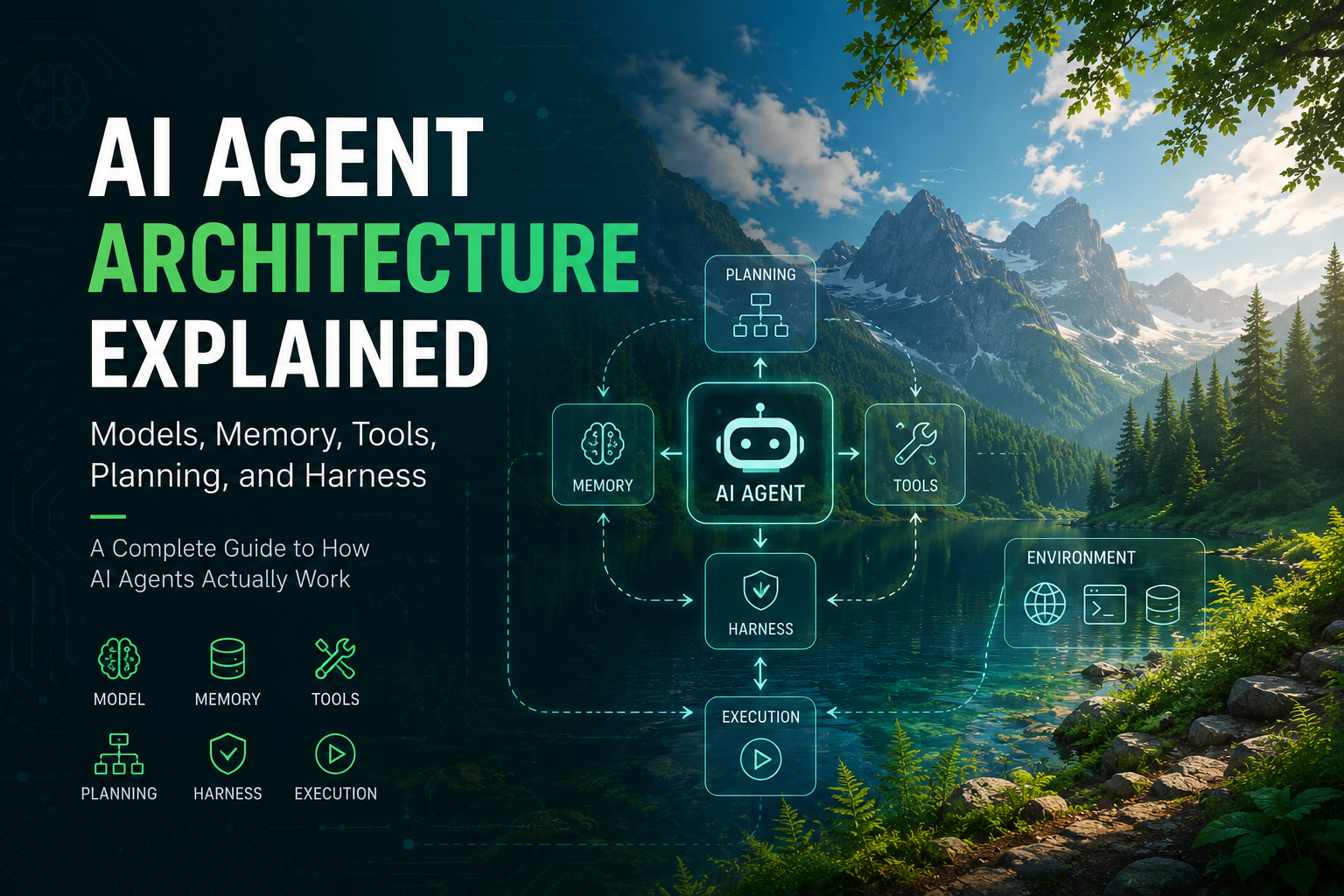
Harness Engineering is the practice of designing the execution framework that allows AI agents to interact with tools, environments, and workflows.
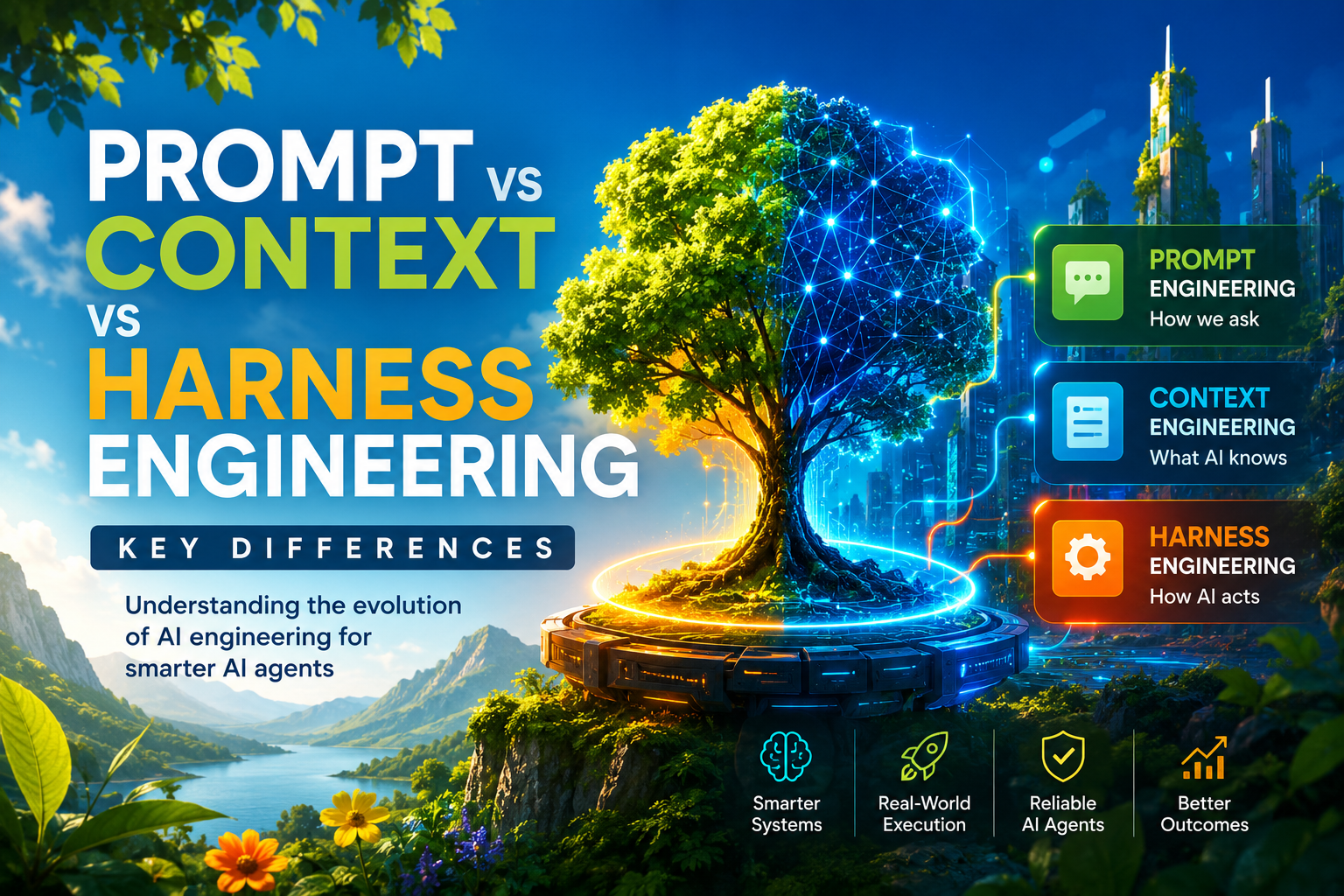
If Prompt Engineering determines how AI receives instructions, and Context Engineering determines what information AI receives, Harness Engineering determines how AI performs actions.
This concept matters more as AI agents evolve beyond chat interfaces.
Understanding the AI Harness
In traditional software testing, a test harness provides a controlled environment for running and evaluating software.
In AI systems, a harness performs a broader role.
It manages:
- Tool access
- Workflow orchestration
- Execution environments
- Safety controls
- Validation systems
- Retry mechanisms
A well-designed harness transforms an AI model into an operational agent.
Core Components of Harness Engineering
Tool Integration
Modern AI agents use external tools.
Examples include:
- Command-line interfaces
- Web browsers
- APIs
- Databases
- Search engines
- Git repositories
The harness controls how these tools are exposed and utilized.
Execution Environments
AI systems often require isolated environments to execute actions safely.
Examples include:
- Docker containers
- Sandboxes
- Virtual machines
- Cloud environments
These environments allow agents to perform tasks without affecting production systems.
Workflow Orchestration
Complex tasks require structured workflows.
A typical AI agent workflow may include:
- Planning
- Research
- Execution
- Verification
- Revision
- Completion
The harness coordinates these stages.
Evaluation and Validation
Advanced agents evaluate their own outputs.
Examples include:
- Unit tests
- Integration tests
- SEO audits
- Security scans
- Performance benchmarks
Evaluation loops improve reliability.
Why Harness Engineering Is Becoming Essential
As AI systems gain autonomy, execution quality becomes more important than response quality.
A modern coding agent must be able to:
- Read files
- Modify code
- Run commands
- Execute tests
- Analyze failures
- Retry automatically
These capabilities come from the harness, not the prompt.
Products such as Claude Code, Cursor Agent, Gemini CLI, OpenAI Codex, and OpenHands all rely heavily on sophisticated harness architectures.
Prompt vs Context vs Harness Engineering
| Category | Prompt Engineering | Context Engineering | Harness Engineering |
|---|---|---|---|
| Primary Question | How should we ask? | What information should AI receive? | How should AI act? |
| Focus | Instructions | Information management | Execution systems |
| Era | 2022-2024 | 2024-Present | 2025-Future |
| Key Technologies | Few-shot, CoT, role prompting | RAG, memory, retrieval | Tools, workflows, evaluation |
| Target Systems | Chatbots | AI assistants | Autonomous agents |
| Performance Driver | Better prompts | Better context | Better execution |
| Representative Products | Early ChatGPT | AI copilots | Advanced AI agents |
Why Prompt Engineering Alone Is No Longer Enough
Prompt Engineering remains an important foundational skill.
However, the industry has learned that prompts cannot compensate for missing knowledge or poor execution frameworks.
Modern AI performance increasingly depends on:
- Retrieval systems
- Knowledge management
- Memory architecture
- Tool integration
- Workflow design
- Evaluation loops
Organizations focusing only on prompts often see diminishing returns.
The most successful AI systems today are built around context and execution.
Future Trends in AI Engineering
The future of AI development is likely to revolve around building intelligent systems rather than writing clever prompts.
Key skills will include:
- Context architecture
- Knowledge retrieval design
- Agent workflow engineering
- Multi-agent coordination
- Tool ecosystem integration
- Automated evaluation frameworks
As AI agents become more capable, developers will spend less time optimizing prompts and more time designing environments where agents can operate effectively.
Conclusion
AI engineering evolved through three stages: Prompt Engineering, Context Engineering, and Harness Engineering.
Prompt Engineering taught us how to communicate with AI. Context Engineering taught us how to inform AI. Harness Engineering teaches us how to operationalize AI.
These disciplines are not competitors. They are complementary layers of modern AI system design.
The future belongs to teams that understand all three. As AI moves from generating answers to completing tasks, the best results will come from building better contexts and better harnesses.
Related articles
- Claude Code Context Commands - Master context management in Claude Code
- Claude.md Best Practices - Set up project instructions for AI coding
- AI Agent Humanizer Skill Guide - Remove AI writing patterns from your content
Frequently Asked Questions
Is Prompt Engineering still relevant in 2026?
Yes. Prompt Engineering remains useful for controlling outputs and improving clarity. However, context and execution systems now have a greater impact on overall performance.
What is the difference between Context Engineering and RAG?
RAG is one technique within Context Engineering. Context Engineering includes retrieval, memory, compression, filtering, and information delivery strategies.
Is Harness Engineering only for AI agents?
Mostly yes. Harness Engineering becomes important when AI systems need to interact with tools, execute workflows, or perform autonomous actions.
Which skill should developers learn first?
Prompt Engineering is the easiest entry point. For production AI applications, Context Engineering and Harness Engineering provide significantly greater long-term value.