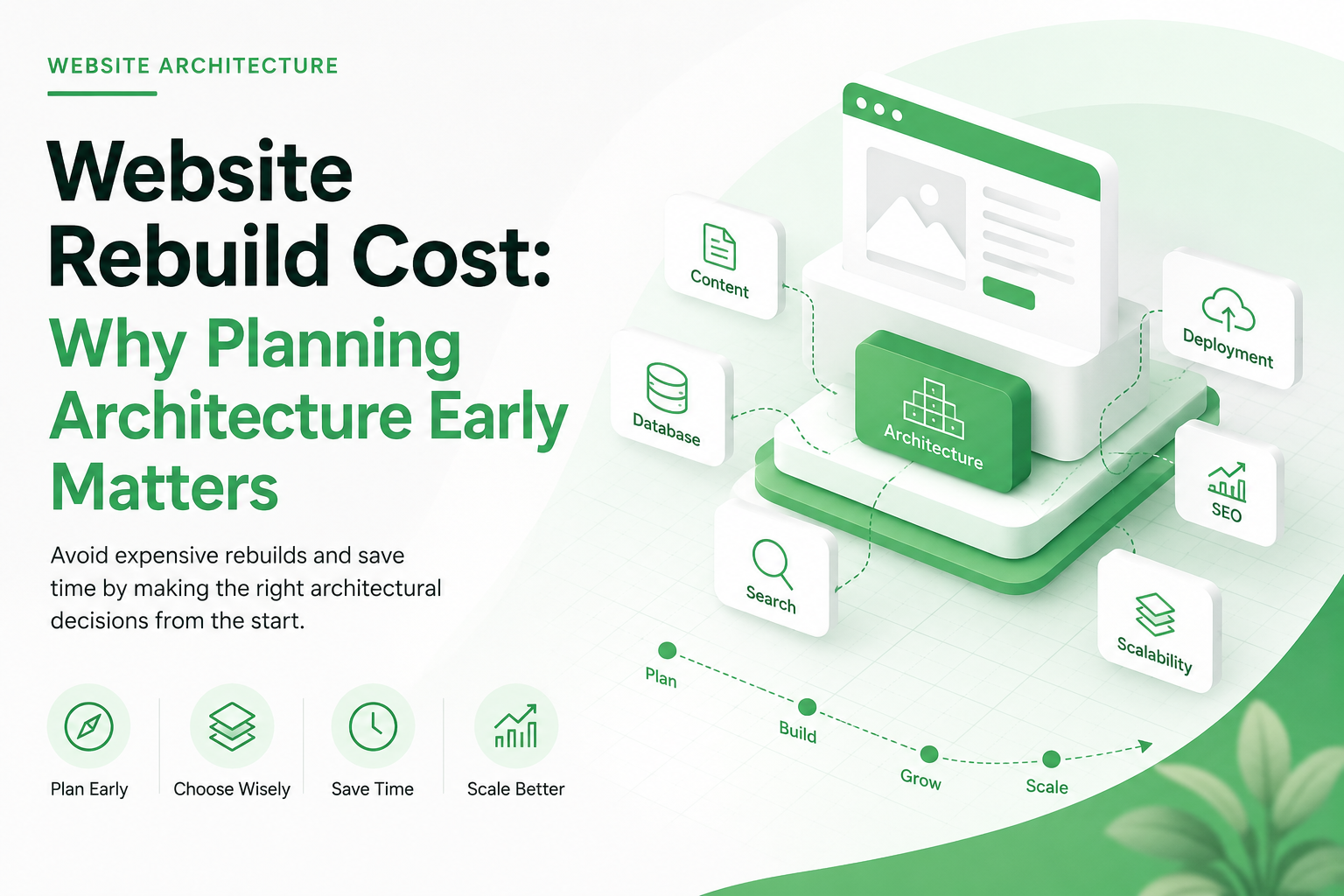
Website Rebuild Cost: Why Planning Architecture Early Saves Thousands
I almost rebuilt my entire website because of a feature that took fifteen minutes to describe but would have taken weeks to build.
When people talk about website costs, they focus on domains, hosting, design, or development. What gets overlooked is the cost of rebuilding after the site is already live.
The most expensive features are not the complex ones. They are the features you add after the original architecture has already been defined. I learned this the hard way a few weeks ago.
I wanted to add multilingual support. Simple idea, right? Create Chinese versions of articles, add a language switcher, publish both versions.
Instead, I got routing changes, SEO adjustments, search indexing problems, layout duplication, navigation bugs, and eventually a complete rollback to a previous version.
Here is what I learned: most website rebuilds are not caused by bad technology choices. They happen because architecture decisions were never made in the first place.
If you are planning a website today, this principle can save you dozens of hours.
Why rebuilds happen
People assume websites get rebuilt because the technology becomes outdated. Sometimes that is true.
More often, the site simply grows beyond what its architecture was designed to handle.
A website launches with a clear goal: publish content, showcase projects, generate leads. Over time, new requirements show up. Multiple languages. Full-text search. User accounts. E-commerce. API integrations.
None of these are unusual. The problem is that every new feature interacts with existing systems.
A seemingly simple addition affects URL structure, navigation, internal linking, search functionality, structured data, analytics, content workflows, and deployment pipelines. That is where technical debt starts accumulating, and the later you make these decisions, the more expensive they become.
My multilingual disaster
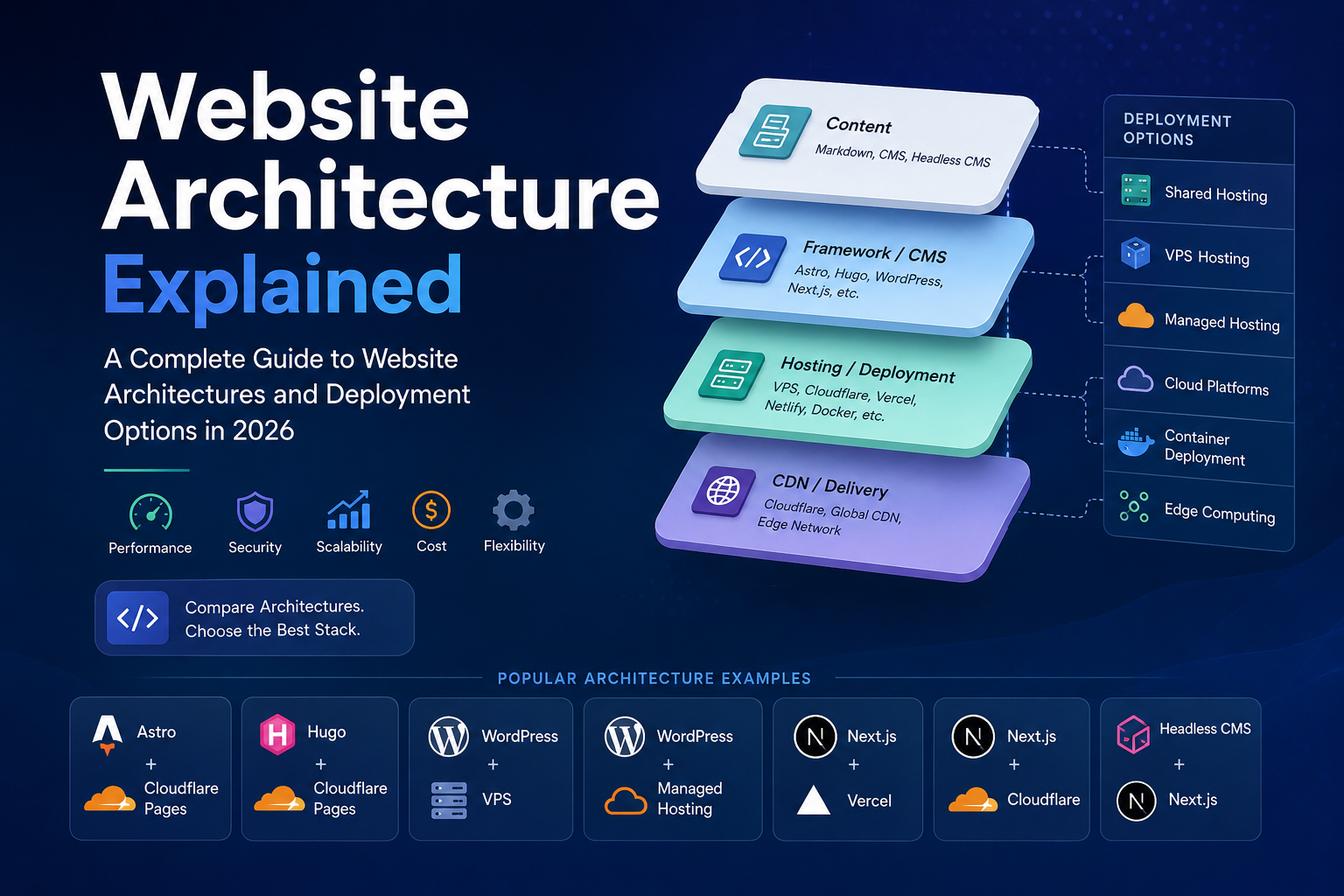
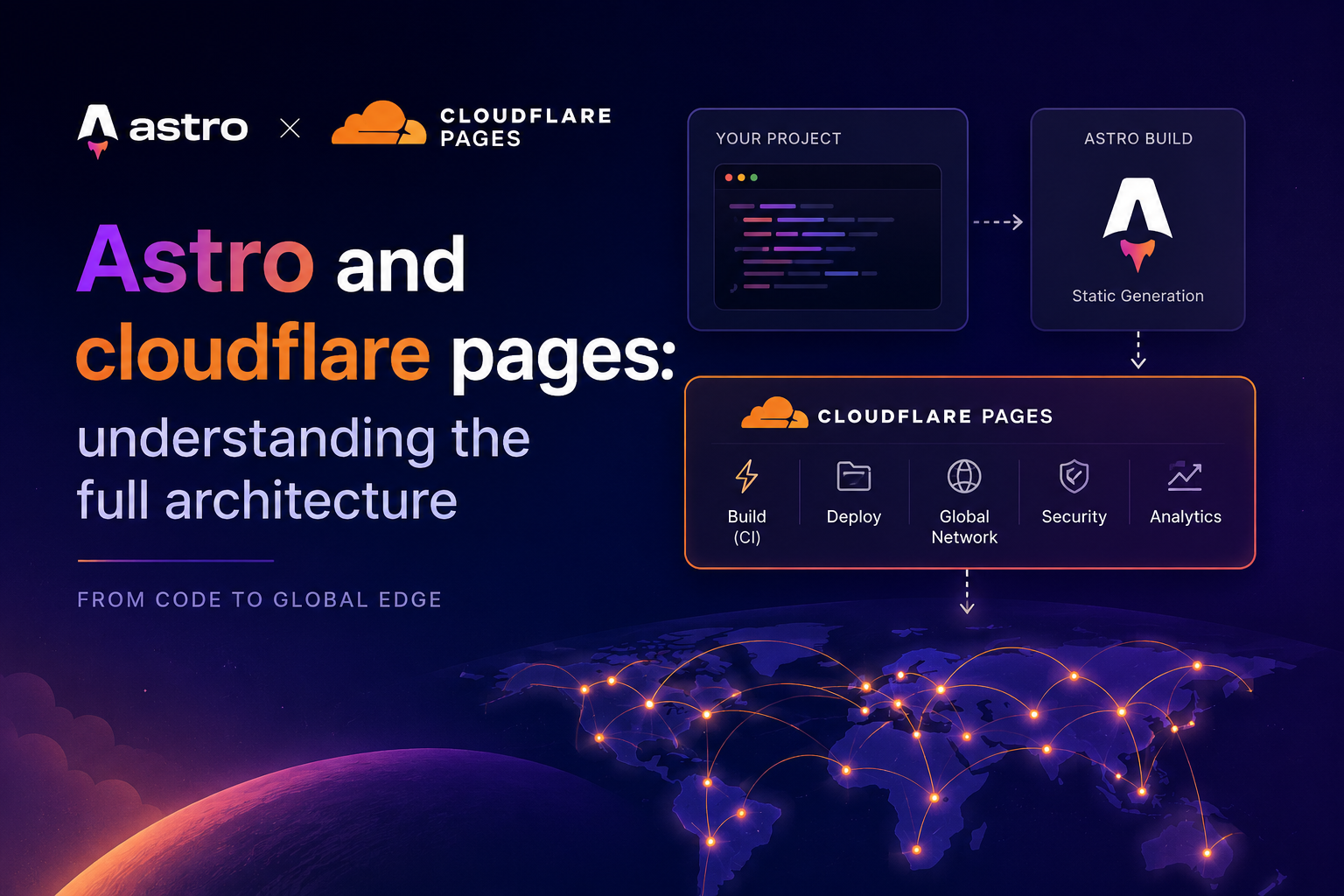
When I launched this site, the architecture was intentionally simple. Astro, Markdown, Cloudflare Pages, Pagefind search. Static site generation. Fast loading, good SEO, no database, no server management. Everything worked.
Then I decided to add Chinese content.
I figured I would just create translated versions of my articles and add a language switcher. The implementation turned out to be anything but simple.
The moment a website becomes multilingual, every assumption changes. Articles that lived at /blog/article-slug/ now needed a /zh/blog/article-slug/ counterpart. Suddenly I needed language-specific routes, hreflang tags, canonical URLs, language switchers, consistent navigation, search indexing per language, sitemap updates, and structured data changes.
What looked like a content problem became an architecture problem. Every system that assumed a single language needed redesign.
Search broke everything
The search functionality was where things got really painful.
Pagefind works perfectly in a single-language setup. After adding Chinese content, I needed separate search results, language-specific indexes, and isolated search experiences.
The search system had to understand which content belonged to which language, which index to load, which search page to display, and how to keep results separated.
What seemed like a small feature started affecting the build process itself. I made several attempts to fix it, each one adding more complexity, until the search system became unreliable.
At that point I had to ask myself: keep fixing this, or go back to a working version?
I went back.
The real cost
Most website owners underestimate what architectural mistakes actually cost. The biggest expense is not money. It is time.
A feature that looks simple on paper expands during implementation. I expected multilingual support to take one or two days. The actual work included routing changes, layout updates, search configuration, SEO implementation, hreflang setup, structured data updates, navigation fixes, mobile testing, bug fixing, and rollback planning.
Every hour spent rebuilding architecture is an hour not spent on growth. While I was debugging language switchers, I was not publishing articles, researching keywords, improving content, or building backlinks. That opportunity cost is invisible but real.
Complex systems also require ongoing maintenance. A simple Markdown site with static hosting is easy to manage. A multilingual site adds content workflows, testing requirements, SEO considerations, and potential failure points. Complexity compounds over time.
Five questions to answer before building
The best way to avoid expensive rebuilds is to answer a few questions before you start coding.
1. Will you need multiple languages?
Many people assume multilingual support can be added later. Technically it can. Architecturally, it may require redesigning your URL structure, content organization, search architecture, and internal linking strategy from the beginning.
2. How important is search?
Search is easy with ten articles. It becomes critical at a hundred, five hundred, or a thousand. Think about search architecture early.
3. Who will manage content?
A solo creator has different requirements from a team. Markdown, a traditional CMS, and a headless CMS each have tradeoffs. Picking the wrong workflow leads to migration projects later.
4. Will users need accounts?
Many websites never need authentication. Others eventually need profiles, comments, purchases, or memberships. This decision determines whether you need a database and backend infrastructure.
5. How large could the site become?
Architecture should support future growth, not just today’s content. A site with twenty articles has different requirements than one with two thousand.
Why simplicity wins
A common mistake is designing for hypothetical future requirements. The result is overengineering.
People add databases they do not need, CMS platforms they do not need, internationalization systems they do not need, and APIs they do not need. All before validating whether the website actually requires any of it.
For a personal content website, Astro plus Markdown plus Cloudflare Pages may be enough for years. Faster development, fewer bugs, easier maintenance, better focus. The goal is not the most advanced architecture. It is the most appropriate one.
How I would build it again
If I started from scratch, I would follow a phased approach.
Phase one: launch quickly. Astro, Markdown, Cloudflare Pages, basic search. No multilingual support, no unnecessary complexity. Focus on publishing content.
Phase two: grow the content library. Improve search, expand topic clusters, strengthen internal linking, improve structured data. Focus on visibility.
Phase three: scale based on evidence. Only after real traffic arrives would I consider multilingual support, CMS migration, or database-backed features. Architecture decisions should be driven by actual needs, not assumptions.
The takeaway
Every website accumulates technical debt eventually. That is unavoidable. What matters is delaying expensive rebuilds by making thoughtful decisions early.
My multilingual adventure taught me this: the feature itself was not the problem. The problem was introducing a major architectural change after the site had been built around a different assumption.
Planning cannot eliminate future rebuilds. But it can reduce how often they happen.
Before you build your next website, ask yourself: what features might I need six months from now? The answers will influence your architecture more than the technology stack.
Because the most expensive feature is usually the one you decide to add after launch.